STEDTRAIN Background
Problems Addressed:
- Many studies have shown that hands-on experiences are the best
teaching tools. Teachers, however, often, especially in the North Alabama-Southern
Tennessee area, have very little access to materials and equipment required
by hands-on approaches.
- Teachers are often over whelmed by technology programs, projects,
or expectations imposed on them.
- Effective teaching of technology requires supportive internal
and external communities. These are often lacking in most schools.
- The community outside the teaching establishment is, for the
most part, quite uninformed and uninvolved in K-12 science and technology
education.
Description of the Seed Grant Program:
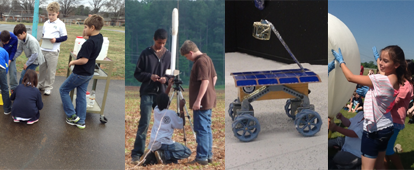
STEDTRAIN encourages and supports the development of the next generation of Tennessee Valley scientists, engineers, and technical professionals by providing local educators with funding to conduct innovative, hands-on STEM programs in their classrooms. These funds are called "Seed Grants" because they are intended to "seed" the students' enthusiasm for science and technology while also encouraging them to pursue technology-oriented higher education opportunities and careers. Tax-deductible donations from forward-looking companies, professional societies, and individuals in the community enable STEDTRAIN.In the first months of every year the STEDTRAIN Committee issues a Call for Proposals to K-12 schools in North Alabama for innovative projects that will "seed" students enthusiasm for science and technology. Grant amounts can range from $200 to $2,500.
Proposals are evaluated and rated by Committee volunteers according to strict criteria. Awards are made in the August -September timeframe. STEDTRAIN volunteers conduct follow-up visits to assigned grantee teachers. Grantees report on their projects at mid- and end-term. Grantees also prepare poster displays and give brief overviews of their projects at the annual STEDTRAIN Conference, which is held in the Spring.
The program supports STEM education in the five North Alabama counties of Madison, Morgan, Marshall, Jackson, and Limestone and Lincoln County, Tennessee. Since the Program began in 1988, it has distributed over $733,862 for 650 individual grants and other worthy educational projects. The grants currently benefit approximately 10,000 students directly and about 20,000 indirectly a year. Funds for the program are derived from donations and sponsorships from professional organizations, area companies, and individuals.
How the Seed Grant Program Addresses the Identified Problems:
- Teachers conceive their own projects. They are therefore of a scope and
of nature to fit the teachers' needs for technology assimilation and curriculum
demands. Furthermore, a self-conceived project is undertaken with more
enthusiasm than an imposed one. Such enthusiasm cannot help but be communicated
to the students.
- New exciting projects generate interest and enthusiasm in fellow
teachers and parents. Teachers who are grant recipients soon become technology
transfer agents and mentors in their schools. Other teachers in the school
see first hand what is being accomplished, become curious, and ask questions
about the new technologies or procedures. These other teachers invariably
adopt and adapt the new technologies to their own needs and desires for
effective teaching.
- The regional nature of the program (currently North Alabama and Southern
Tennessee) helps rapid diffusion of technology education and resources
throughout the region. Such diffusion is especially needed in rural and
some urban areas of this region. Additionally, the fact that a community
organization conducts the program reduces the problem of self-interest
barriers often exhibited by school systems - barriers which work against
widespread diffusions of technology education and resources throughout
the region.
- The STEDTRAIN volunteers, most of who are technical professionals,
benefit the teachers by providing them with technical insights and personal
interest (shown during visits volunteers make to grantee schools). Furthermore
the STEDTRAIN volunteers provide valuable feedback to the technical professional
community and to the educational establishments.
- The public exposure grant projects receive at the STEDTRAIN
Conference helps to inform the outside community about the advantages of
teacher-generated, "hands-on" science projects.
- The poster displays and the verbal overviews the grantees give
annually generate a community of grantee teachers who learn from one another's
experiences and ideas. This is still another kind of supportive community
that hastens technology education diffusion.
- Furthermore, the STEDTRAIN volunteers provide valuable feedback
to the technical professional community and to the educational establishments.
Some Results of Seed Grants:
A teacher in an "on alert" elementary school used materials purchased with grant funds for math instruction. Youngsters from her class won a national math competition.An "Amusement Park Physics" grant inspired a middle school math class to win a State mathematics competition.
High school youngsters became so proficient in performing DNA analyses (equipment purchased with grant funds) they amazed professionals.
Teachers who have received grant awards have inspired fellow teachers to apply for their own




 Copyright © 2026